
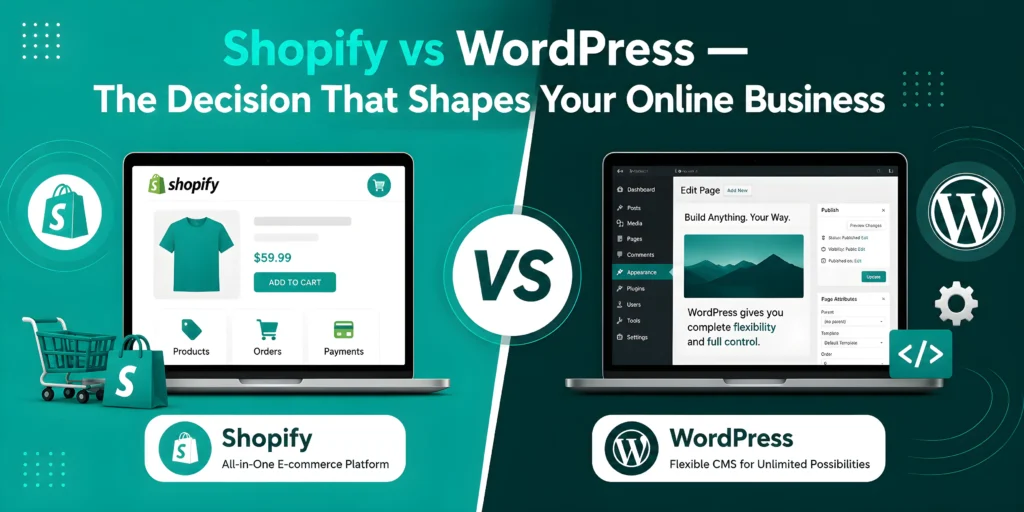
Introduction: Shopify vs WordPress The Decision That Shapes Your Online Business
If you’re planning to build an online store, chances are you’ve already asked yourself:
Shopify vs WordPress Which one is better?
At first, it feels like a simple comparison between two popular platforms. But once you start exploring, you realize it’s a deeper decision, one that directly impacts your business growth, flexibility, and long-term costs.
Some entrepreneurs want something quick, simple, and ready to go. Others want full control, customization, and the ability to scale without limitations.
That’s exactly where the difference between Shopify and WordPress begins.
This guide isn’t just another surface-level comparison. It’s built to help you understand how each platform works in real-world scenarios so you can confidently choose the one that fits your goals.
Understanding the Core Difference Between Shopify and WordPress
Before we compare features, it’s important to understand how these platforms are fundamentally different.
Shopify is an all-in-one ecommerce platform. It handles hosting, security, updates, and performance for you. Everything is built around simplicity, allowing you to launch and manage a store without technical knowledge.
WordPress, on the other hand, is a flexible content management system (CMS). It gives you full control over your website—but you’re responsible for managing hosting, plugins, and performance.
👉 In simple terms:
- Shopify focuses on ease and convenience
- WordPress focuses on control and customization
This core difference influences everything from pricing to SEO.
Key Differences at a Glance
Before going deeper, here’s a quick comparison table:
| Feature | Shopify | WordPress |
| Setup | Very easy | Moderate |
| Hosting | Included | Required |
| Customization | Limited | Unlimited |
| SEO | Good | Excellent |
| Maintenance | Minimal | Required |
| Scalability | High | Very High |
This table gives you a quick idea but the real difference shows up when you look at each factor in detail.
Shopify vs WordPress Pricing
One of the most important decision-making factors is cost.
When people search for “Shopify vs WordPress pricing”, they often expect a simple answer—but the reality is more nuanced.
Shopify uses a subscription model. You pay a fixed monthly fee, which includes hosting, security, and support. This makes it predictable and easy to manage.
However, as your store grows, additional costs can appear:
- Paid apps
- Premium themes
- Transaction fees
WordPress, in contrast, doesn’t charge for the platform itself. But you’ll need to pay for:
- Hosting
- Domain
- Plugins
- Development (if needed)
At the beginning, WordPress often looks cheaper. But for more advanced stores, costs can increase depending on customization.
👉 The real difference is not cost—but cost structure:
Customization: The Biggest Advantage of WordPress
This is where WordPress truly stands out.
With WordPress, you are not limited by the platform. You can customize anything from design and layout to functionality and backend logic. Whether you want a unique checkout process or a completely custom user experience, WordPress makes it possible.
Shopify, while flexible to an extent, operates within a controlled ecosystem. You can customize themes and use apps, but there are limits. Advanced customization often requires working within Shopify’s framework.
This is why many growing businesses eventually move to WordPress.
Because at scale, flexibility becomes more important than convenience.
SEO Comparison
SEO is one of the biggest traffic drivers for any online store.
If you search for “Shopify vs WordPress SEO”, most experts agree on one thing: WordPress offers more control.
Shopify comes with built-in SEO features that are good enough for most stores. It handles:
- Mobile optimization
- Sitemap generation
- Basic metadata
But WordPress goes further.
With plugins and full backend access, you can:
- Optimize URLs
- Control technical SEO
- Implement advanced schema
- Improve internal linking
This makes WordPress a stronger choice for businesses that rely heavily on organic traffic.
👉 Winner: WordPress (for advanced SEO)
Ease of Uses
Ease of use is where Shopify really shines.
If you’re a beginner searching for “Shopify vs WordPress for beginners”, Shopify is usually the better option.
You can:
- Set up a store quickly
- Add products easily
- Manage everything from one dashboard
WordPress requires more effort. You need to:
- Set up hosting
- Install plugins
- Manage updates
It’s not difficult but it takes time to learn.
👉 Winner: Shopify (for simplicity)
Shopify vs WordPress Customization
Customization is where WordPress takes the lead.
Shopify allows you to customize your store but within certain limits. You rely on themes and apps.
WordPress gives you complete control.
You can:
- Design anything you want
- Add custom features
- Modify every part of your website
This makes WordPress ideal for businesses that want a unique and scalable solution.
👉 Winner: WordPress
Shopify vs WordPress Security
Security is critical for any ecommerce business.
Shopify handles security for you. It includes:
- SSL certificates
- Data protection
- Automatic updates
WordPress requires you to manage security yourself. This includes:
- Installing security plugins
- Updating software
- Monitoring threats
👉 Winner: Shopify (for ease of security)
Shopify vs WordPress Performance & Speed
Performance affects both user experience and SEO.
Shopify provides consistent performance because it’s fully managed.
WordPress performance depends on:
- Hosting quality
- Optimization
- Plugins
With proper setup, WordPress can be just as fast or even faster.
👉 Result: Depends on implementation
Shopify vs WordPress for eCommerce
When comparing “Shopify vs WordPress for ecommerce”, the decision comes down to simplicity vs flexibility.
Shopify is built specifically for ecommerce. Everything is optimized for selling.
WordPress requires WooCommerce but offers more flexibility.
👉 Choose Shopify if you want simplicity
👉 Choose WordPress if you want customization
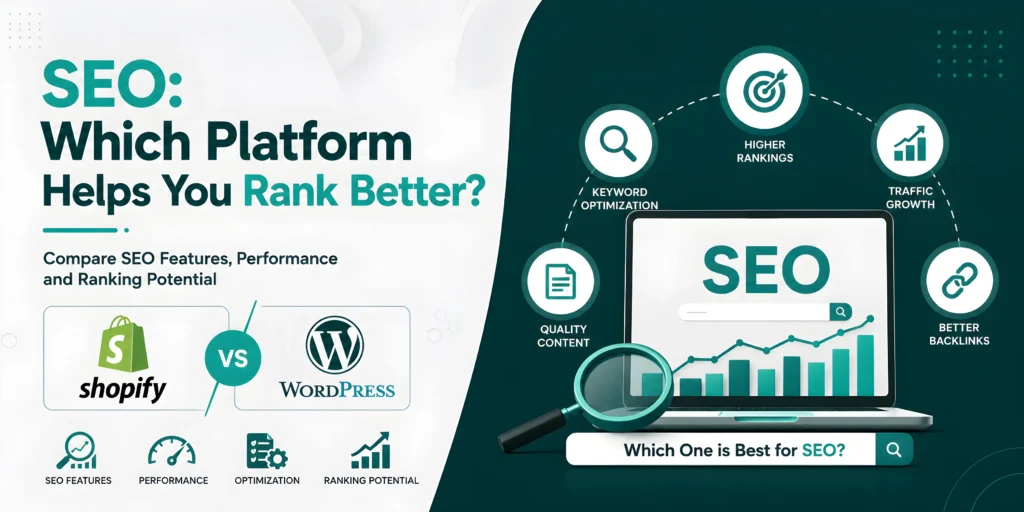
SEO: Which Platform Helps You Rank Better?
Search engine optimization is one of the most important factors for long-term growth.
Shopify provides solid built-in SEO features. It handles technical basics like sitemaps, mobile optimization, and page speed quite well. For many stores, this is enough.
But WordPress takes SEO to another level.
With plugins and full backend access, you can control everything URLs, meta tags, schema markup, page structure, internal linking, and performance optimization.
If your strategy involves content marketing, blogging, or ranking for competitive keywords, WordPress gives you a clear advantage.
This is why most high-traffic websites and blogs prefer WordPress.
Pros and Cons of Shopify vs WordPress
Shopify Pros:
✔ Easy setup
✔ All-in-one solution
✔ Reliable support
Shopify Cons:
❌ Monthly cost
❌ Limited customization
WordPress Pros:
✔ Full control
✔ Better SEO
✔ Unlimited customization
WordPress Cons:
❌ Requires maintenance
❌ Learning curve
Which is Better – Shopify or WordPress?
After everything we’ve covered, the answer becomes clearer.
Choose Shopify if:
- You want a quick and easy setup
- You don’t want to deal with technical details
- You prefer an all-in-one solution
Choose WordPress if:
- You want full control
- You plan to scale long-term
- You care about advanced SEO and customization
There’s no universal “best” platform.
Only the best platform for your situation.
A Practical Insight Most Guides Don’t Tell You
Many businesses start with Shopify because it’s easy.
But as they grow, they realize they need more control more flexibility, better SEO, and advanced customization.
That’s when they transition to WordPress.
If you already know you’ll need that flexibility in the future, starting with WordPress might save you time later.
Final Thoughts
Choosing between Shopify and WordPress isn’t about picking the more popular option.
It’s about choosing the platform that aligns with your goals, your resources, and your vision for the future.
Make the right choice now, and everything else becomes easier.
FAQs
1. Shopify vs WordPress – which is better?
It depends on your needs. Shopify is easier, while WordPress is more flexible.
2. Is WordPress better for SEO than Shopify?
Yes, WordPress offers more advanced SEO control.
3. Which is cheaper, Shopify or WordPress?
WordPress can be cheaper initially, but costs vary.
4. Can beginners use WordPress?
Yes, but it requires some learning.
5. Which platform is best for ecommerce?
Shopify is easier; WordPress is more customizable.
6. Can I switch from Shopify to WordPress?
Yes, migration is possible with proper planning.




 Web & Design
  Development
  Seo Expert
  Online Marketing
  Industries